Haze: Do Not Stop at Apologies
Transboundary haze is once again testing Indonesia’s capacity to manage environmental disasters while maintaining the trust of neighboring countries. A report by *The Straits Times* on October 12, 2026, highlighted that President Prabowo Subianto ordered firmer handling of forest and land fires, but offers of assistance from Malaysia and Singapore were not discussed in the meeting. On the same day, the *Malay Mail* highlighted political pressure from Johor, demanding that Indonesia stop making excuses and issue an apology for the impact of the haze felt by the Malaysian public.
Both reports raise valid concerns. Transboundary haze poses health consequences, disrupts educational and transportation activities, and affects relations between countries. The Indonesian government cannot dismiss these impacts simply by citing national sovereignty or technical difficulties on the ground. However, to understand this issue fully, the public also needs to look at the climate context, the scale of mitigation operations, and the available regional cooperation mechanisms.
The haze issue cannot be resolved merely through an exchange of political demands. What is more important is ensuring that criticism leads to measurable policy improvements.
When El Nio Becomes a Risk Factor, Not an Excuse
Current climate conditions provide critical context for the ongoing fires. The Meteorology, Climatology, and Geophysics Agency (BMKG) noted that the three-month ENSO index for the August to October period reached +3.08 in the first ten days of October, which is categorized as a very strong El Nio. BMKG also estimated that around 79.65 percent of Indonesia’s territory experienced low rainfall, namely 0–50 millimeters per ten-day period, during that time (BMKG, 2026).
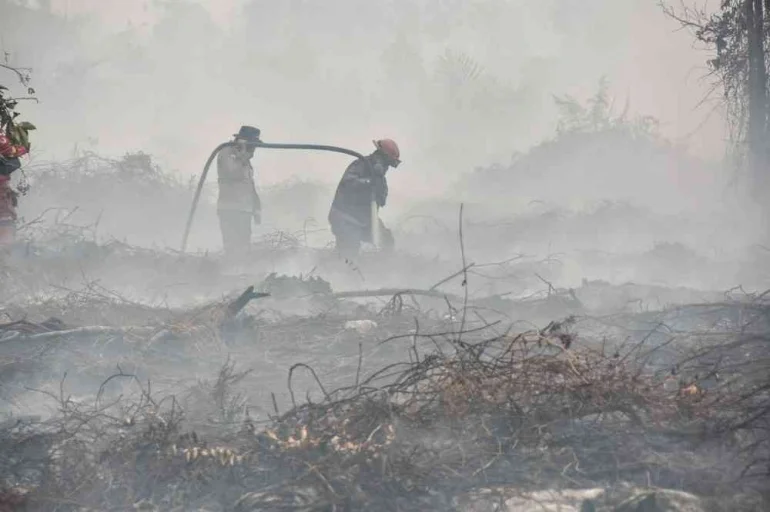
These conditions increase the risk of fires, accelerate the drying of vegetation, and complicate firefighting efforts, especially on peatlands. Fires smoldering beneath the peat surface can persist even after surface flames have been extinguished. Therefore, successful management depends not only on the number of personnel and equipment but also on the ability to detect hotspots, control peatland water levels, break the fire’s spread, and prevent recurring fires.
However, meteorological explanations must be framed properly. El Nio is not the sole cause of all fires, let alone a justification for illegal land-burning practices. Dry weather increases vulnerability, while human activity, land management, and law enforcement determine whether that vulnerability develops into a disaster.
The experience of 2015 provides a crucial lesson. The World Bank estimated that forest and land fires that year scorched around 2.6 million hectares and caused economic losses to Indonesia of approximately US$16.1 billion (World Bank, 2016). That crisis demonstrated how droughts and El Nio exacerbate fires that are also linked to human activities and weak control over land burning.
Therefore, two extreme views are equally inadequate. Attributing all fires entirely to natural phenomena ignores human responsibility. Conversely, ignoring climate factors results in an incomplete understanding of the scale and difficulty of the response.
A more appropriate approach is to scientifically acknowledge the climate factor, take firm action against the sources of the fires, and strengthen prevention before the dry season reaches its peak.
Measuring the Government’s Response, Not Just Assessing Its Statements
The Straits Times reported that over 60,000 personnel have been deployed across six provinces in Sumatra and Kalimantan. The same report noted 174,694 cases of acute respiratory infections in seven affected provinces between August 18 and September 21, 2026 (The Straits Times, 2026).
These figures must be read together. The large deployment of personnel indicates that the government has mobilized resources to combat the fires. Meanwhile, the number of respiratory illness cases shows that the threat to public health remains severe. The data does not prove that the government has succeeded, but neither is it sufficient to conclude that the government has made no effort.
A more productive question is whether the deployment of personnel has resulted in a reduction of the burned area, whether firefighting efforts were swift enough, whether the public received adequate health protection, and whether the sources of the fires are being consistently prosecuted.
Using these metrics, policy evaluation becomes more substantive. The government needs to regularly publish updates on hotspots, burned areas, firefighting operation status, law enforcement outcomes, and air quality indicators. This data should be available in a format that allows the public to compare conditions across regions and assess changes over time.