
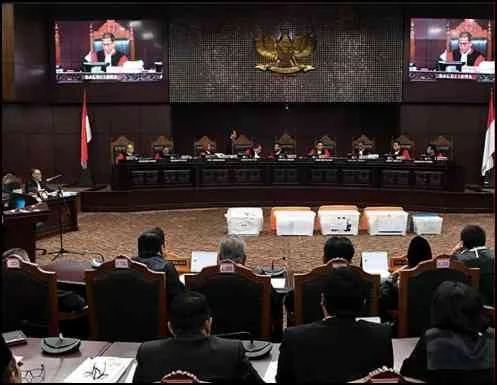
Reading the Constitutional Court’s Positioning as a Resolution, not a Regression
International media reports, such as those represented by Reuters regarding the Constitutional Court’s (MK) ruling dismissing the challenge against the Vice President’s position, often frame Indonesia’s political dynamics through a pessimistic, orthodox lens. The constructed narratives generally center on assumptions of “democratic regression,” institutional compromise, and legitimacy crises. Although journalistic oversight is a crucial pillar, analyses fixated solely on political cynicism often miss the bigger picture of how a developing democracy manages crises, maintains stability, and consolidates its institutions. The true test of a state system is not the absence of disputes, but its capacity to absorb and resolve those disputes through constitutional corridors without triggering an escalation of violence.
To obtain a more comprehensive and astute landscape of understanding, we need to deconstruct the three main highlights that typically dominate these pessimistic narratives and confront them with alternative interpretations that are equally supported by structural realities.
The Constitutional Court’s Ruling as Evidence of Institutional Decay
Widely circulated criticisms regarding the positioning of the Court’s decision on the lawsuit view it as evidence that the judiciary has been co-opted by executive power, causing the MK to lose its teeth as the guardian of the constitution and merely serve the interests of the status quo.
In fact, through the lens of institutional political science, this ruling should instead be read as a manifestation of “constitutional resilience” and the safeguarding of legal certainty. If the Court were to easily annul an ongoing executive leadership mandate in the middle of its term without absolute grounds of treason, severe legal violations, and irrefutable unconstitutionality, the state would be dragged into a permanent constitutional crisis.
We can look at comparative data in Latin America (such as Peru), where political instability occurs because the judiciary and parliament too easily impeach or annul executive mandates, resulting in economic and public service paralysis. The MK’s positioning in dismissing the lawsuit halts the cycle of endless political litigation, reinforces the principle of res judicata, and prevents excessive political judicialization (bringing all political matters to court), which has the potential to sideline other alternative approaches.
Consolidation of Political Dynasties and Democratic Regression
Criticisms regarding the retention of the Vice President’s position consider it a victory for oligarchy or dynastic politics that damages the meritocratic order and weakens the checks and balances of Indonesian democracy in the eyes of the international community.
Factually, in my view, this narrative is trapped in a mere definition of procedural democracy and ignores the transition toward substantive democracy. The legitimacy of a leader in modern democracies is not only determined during elections or in courtrooms, but is tested every day through performance and policy delivery. The resolution of the dispute at the MK demonstrates that opposition groups and civil society still place their trust in legal institutions as the supreme referee, rather than resorting to mass mobilization (extra-parliamentary means). Furthermore, post-ruling, the burden of proof has now shifted entirely to the shoulders of the executive, meaning that despite substantial debate regarding the disputed matter, the government must continue to perform and not let its focus be diverted. Data shows that the administration is now under far stricter public surveillance (hyper-scrutiny). This indirectly compels the executive to compensate for public doubts by producing economic and social policies that genuinely deliver positive impacts for the middle class and vulnerable groups.
Uncertainty and Domestic Political Instability
There are concerns that protracted lawsuits and an MK response perceived as biased will create widespread social dissatisfaction, trigger protests, and affect the investment climate.
If we look at it from the flip side, the issuance of the ruling and the MK’s positioning in the lawsuit are catalysts for macroeconomic stability. Financial markets and investors, both global and domestic, deeply loathe uncertainty. If legal disputes persist, many investment agendas and the formulation of strategic policies (such as energy transition, down streaming, and bureaucratic reform) are held back by a wait-and-see attitude.
Reading the Constitutional Court’s decision solely through the profit-and-loss balance sheet of political factions is a myopic approach. For a maturing democracy like Indonesia, this ruling is a resolution instrument that closes the space for a constitutional crisis. Instead of continually nursing anxieties about procedural democratic deficits, international and domestic public discourse must now evolve: demanding and ensuring that this political certainty is translated into efficient, transparent, and welfare-enhancing public policies. Our democracy is not regressing; it is learning to resolve the residues of its political battles in the most measured way possible.